
Reports & briefs
20 November 2023
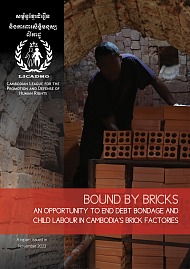
Debt bondage and child labour plague Cambodia’s brick factories, as decades of inaction by the Cambodian government and construction and real estate sectors have allowed these human rights abuses to continue unchecked.
Today, on World Children’s Day 2023, the Cambodian League for the Promotion and Defense of Human Rights (LICADHO) is renewing its call for all actors to immediately end these shameful practices. “Bound by Bricks: An Opportunity to End Debt Bondage and Child Labour in Cambodia’s Brick Factories" is a report based on information documented by LICADHO from 21 brick factories across Kandal province and the capital Phnom Penh.
29 August 2023
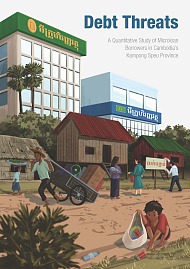
Equitable Cambodia (EC) and the Cambodian League for the Promotion and Defense of Human Rights (LICADHO) today are releasing Debt Threats: A quantitative study of microloan borrowers in Cambodia’s Kampong Speu province. The report features findings from a survey of 717 households.
The research shows that widespread over-indebtedness has led to significant numbers of serious human rights abuses – including hunger, child labour, and coerced land sales – across Kampong Speu province. Borrowers are making unacceptable sacrifices to repay loans that are overwhelmingly collateralised with land titles, and that often far exceed borrowers’ incomes and ability to repay.
10 March 2023
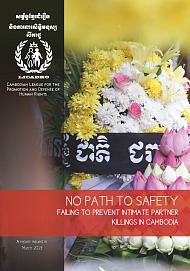
LICADHO has today published “No Path to Safety: Failing to Prevent Intimate Partner Killings in Cambodia”, a report on the murders of 26 women and five children committed by current or former intimate partners between January 2020 and June 2022.
Violence against women is one of the most pervasive human rights violations in Cambodia, yet a flawed and often unenforced legal framework frequently allows violence to continue and escalate. Too often, this leads to murder. Today, LICADHO is demanding change.
25 November 2022
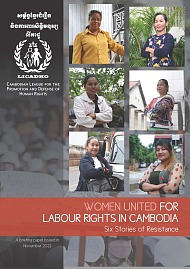
LICADHO is marking the 16 Days of Activism against Gender-Based Violence by celebrating all women who are standing up for labour rights and fighting to end gender-based violence at work. In “Women United for Labour Rights in Cambodia”, LICADHO shares the stories and recommendations of six activists fighting as leaders and members of trade unions, associations and federations.
Together, they represent factory workers, sex workers, entertainment workers, casino workers, teachers, tuk tuk drivers, domestic workers and more. They are all calling out the violence and sexual harassment that their members face at the workplace.
29 September 2022
The Covid-19 Law, officially titled the Law on Preventive Measures Against the Spread of Covid-19 and Other Severe and Dangerous Contagious Diseases, was hurriedly passed on 11 March 2021 without consultation with civil society and other stakeholders, and took immediate effect. The law, reinforced by two hastily drafted sub-decrees on health and administrative measures, grants the government extraordinarily broad powers and discretion to significantly interfere with fundamental social, political and economic rights. There are inadequate provisions for independent oversight of authorities’ measures, and a lack of meaningful limits on the duration and scope of oppressive restrictions. Over half the text of the Covid-19 Law is devoted to penalties, including prison sentences of up to 20 years for vaguely phrased violations.
26 April 2022
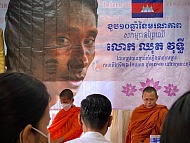
On the tenth anniversary of his murder, we the undersigned civil society groups, non-governmental organisations, activists and grassroots communities reiterate the call for relevant institutions including the Ministry of Justice, Ministry of Interior, Ministry of National Defense and Koh Kong provincial authorities to undertake a credible and thorough investigation to hold all those responsible for his murder to account.
7 February 2022
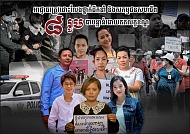
We, the undersigned civil society organizations working on the promotion and protection of human rights labor rights, land rights , environmental activists, independent analyst and social researcher in the Kingdom of Cambodia, wish to inform His Excellency of our deep disappointment at the authorities’ abuse of the Cambodian legal framework to wrongly arrest, detain and charge eight union leaders and continues to arrest more union activists for their peaceful exercise of freedom of association and freedom of assembly, both of which are protected in domestic and international law.
Therefore, we, the undersigned civil society organizations working on the promotion and protection of human rights and labor rights in Cambodia, request His Excellency to intervene in order to have the eight jailed union leaders and activists released and all charges against them dropped and to find a just and fair resolution to this labor dispute.
25 November 2021
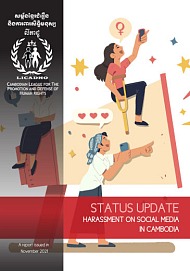
Facebook dominates Cambodia’s social media space and, through inaction and neglect, has created a platform that is too often a site of government surveillance and harassment, as well as sexual harassment, discrimination, threats, and other harassment from private individuals.
In a new report, the Cambodian League for the Promotion and Defense of Human Rights (LICADHO) is calling on Facebook, the Cambodian government, and other social media companies to do more to protect human rights online. “Status Update: Harassment on Social Media in Cambodia” is a report detailing the findings of a survey of more than 700 people conducted by LICADHO. More than one-third (38%) of respondents had experienced online harassment, with LGBT+ people, youth, and activists facing such harassment at even higher rates. Moreover, 20% percent of women respondents had experienced sexual harassment online.
28 June 2021
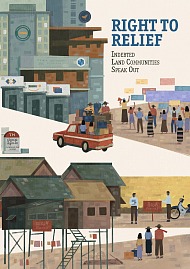
Right to Relief is a call for immediate action to be taken by microloan providers - both microfinance institutions (MFIs) and banks - as well as their international investors, including state development banks from Europe and the United States, to investigate the scope of human rights abuses and provide relief to borrowers who have suffered from predatory lending and collection practices. The research spans eight provinces in Cambodia, with each community profile featuring information about the community’s formation in response to a land conflict, and the threat to land tenure security and other human rights now posed by over-indebtedness.
A website features highlights from the 14 community profiles, while a PDF of the report contains more complete profiles and additional information about the project.
18 December 2020
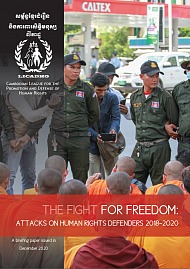
The Cambodian League for the Promotion and Defense of Human Rights (LICADHO) today is releasing “The Fight for Freedom: Attacks on Human Rights Defenders, 2018-2020”.“The Fight for Freedom” is not an exhaustive list of all attacks targeting human rights defenders since the beginning of 2018. Instead, it highlights a number of high-profile cases where human rights defenders have been targeted for intimidation, arrest or imprisonment while trying to peacefully exercise their rights to association, assembly and expression as guaranteed both in Cambodia’s constitution and under international law.
10 December 2020
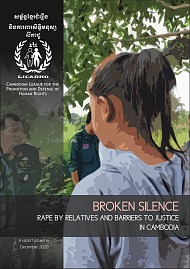
Women and children who are raped by a family member are too often being denied both the safety that they need and the justice they are entitled to. This December, to mark the global 16 Days of Activism against Gender-Based Violence campaign which runs from 25 November to 10 December, LICADHO is releasing “Broken Silence: Rape by Relatives and Barriers to Justice in Cambodia”.
27 July 2020
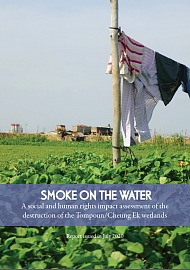
More than one million people across Phnom Penh are facing the risk of increased flooding and over one thousand more families are at risk of evictions, loss of income and food insecurity as the ING City project and other unsustainable developments destroy the Tompoun/Cheung Ek wetlands in the capital’s south.
30 June 2020
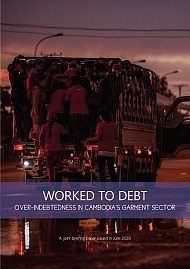
Tens of thousands of garment workers in Cambodia will struggle to repay microfinance debts during work stoppages and factory suspensions caused by COVID-19, creating a mounting human rights crisis as they struggle to feed their families and hold onto their land under immense pressure from microfinance institutions (MFIs). Without immediate debt relief, many of these workers will resort to selling their land or their homes, eating less food or taking out even more loans to repay their debts.
In Worked to Debt, a joint briefing paper between the Cambodian Alliance of Trade Unions (CATU), the Center for Alliance of Labor and Human Rights (CENTRAL) and the Cambodian League for the Promotion and Defense of Human Rights (LICADHO), researchers surveyed more than 150 workers – most of them women – from three factories in Phnom Penh and Kampong Chhnang to investigate how workers were coping with their debts as hundreds of factories suspended operations as a result of the global pandemic.
5 May 2020
“The benefits of MFIs are short, but the fear is long.”
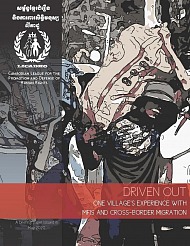
Throughout Cambodia’s northwest, widespread microfinance debt is pushing families from their homes to find work across the Thai border. In this briefing paper “Driven Out: A study on MFIs and Cross-Border Migration”, LICADHO focuses on a single village in Banteay Meanchey province to dig deeper into the link between microfinance debt and migration in Cambodia’s borderlands. Through interviews conducted with remaining family members from 30 households, LICADHO’s researchers found that over-indebtedness to microfinance institutions (MFIs) was the primary motivating factor for migration in the village.
“Far too many families have had to leave their homes and their country to repay microfinance institutions,” said LICADHO director Naly Pilorge. “Now, with tens of thousands of former migrant workers unable to work in Thailand due to COVID-19, the government and MFIs must help these borrowers by suspending repayments and returning land titles.”
7 August 2019
More than 2 million Cambodians currently have a loan with a microfinance institution, or MFI. Levels of debt have skyrocketed in recent years, leading to a number of human rights abuses, including coerced land sales, child labour, debt-driven migration, and bonded labour, according to a joint report from the Cambodian League for the Promotion and Defense of Human Rights (LICADHO) and Sahmakum Teang Tnaut (STT).
Collateral Damage: Land Losses and Abuses in Cambodia’s Microfinance Sector details the size and scope of Cambodia’s MFI sector and seeks to highlight the human rights abuses that researchers discovered. The research spans 10 communes in 4 provinces as well as Phnom Penh and features seven detailed case studies of abuses, chosen from the 28 MFI clients who suffered human rights abuses that were interviewed by researchers.
31 October 2018
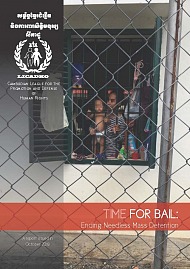
Until proven guilty, Cambodian citizens accused of a crime have the right to be presumed innocent, under Cambodian and international law. For most charged persons, this should mean being given the chance to avoid pre-trial detention through bail proceedings.
This briefing paper, mainly based on LICADHO’s extensive work in the prison system, demonstrates how rampant under-use of bail proceedings results in excessively long periods of pre-trial detention which have far reaching consequences for the lives of individuals, families and communities. For the purposes of this report, LICADHO defines pre-trial detention as those persons detained who have not yet been to trial.
30 March 2018
Thousands of Cambodian children were adopted overseas between the late 1980s and 2009. During that time it emerged that many of the adopted children were not orphans but had parents who placed them in orphanages because of extreme poverty. Their parents placed them there on the understanding that they would return home at a later date. They did not consent to their children's adoption. Instead, orphanage directors, with the help of local authorities, created documents falsely stating that the children were orphans or had been abandoned.
When evidence of this came to light, many countries suspended the adoption of children from Cambodia and in 2009 Cambodia itself suspended them. The parents of the children adopted abroad were often illiterate and lacked awareness of their rights or of where to turn to for help and so were unable to find out what had happened to their children.
In a new report Cambodia’s Stolen Children: Fraud and Corruption in the Inter-Country Adoption System released today, LICADHO describes the cases of several birth mothers who recently approached the organisation seeking help finding their children who had been adopted overseas in the 2000s.
2 December 2017
To mark the global campaign 16 Days of Activism against Gender-Based Violence, running from November 25 to December 10, LICADHO is publishing a new report No Punishment, No Protection: Cambodia’s Response to Domestic Violence. It presents evidence of the failure of the Cambodian justice system to properly protect victims of domestic violence or to punish the perpetrators.
30 July 2017
As Cambodia’s human rights situation continues to backslide, exposing and speaking out against state-perpetrated abuses is ever more crucial. In the last two years, however, human rights defenders and other critical or independent voices have been among the main victims of Cambodia’s fractious political situation. In July 2016, one human rights defender who regularly offered dissenting views paid the ultimate price. Political analyst Kem Ley was shot dead in broad daylight; although the main suspect was subsequently convicted of murder after a four-hour trial, to date, there has been no credible thorough investigation into the killing.
In this latest in a series of recurring briefing papers, LICADHO sets out threats facing those who stand up for human rights in today’s Cambodia. Long-standing tactics used to silence human rights defenders – judicial harassment by a politicized court system; state-sponsored violence; and intolerance of peaceful protest – have been reinforced by new incapacitating laws and targeted digital surveillance. Although the examples presented in this paper are by no means exhaustive, taken together they provide a snapshot into the kinds of abuses that human rights defenders have been routinely subjected to in Cambodia over the last two years. With a national election only a year away, it is more than likely that these trends and tactics provide a window into the future, and that attacks on human rights defenders will continue to be part of the government’s ongoing efforts to further restrict the basic constitutional freedoms of Cambodian citizens.

10 July 2017
Ahead of the one-year anniversary of the killing of Kem Ley, we, the undersigned, reiterate our concerns regarding the apparent lack of progress in investigating this case, as well as the inadequate investigation and trial of Oeuth Ang, the only person yet convicted or charged in relation to Kem Ley’s death. In light of the inadequacy of the investigation, we urge the Royal Government of Cambodia (“RGC”) to establish an independent and impartial Commission of Inquiry, in line with international standards, to continue the investigation.